10 movements to the music of Philip Glass
Early works by artists often have a tonality all their own. They are timeless and remind us of the energy and radicality that characterise the emergence of a style of their own. Anne Teresa De Keersmaeker, for instance, stepped onto the international stage of contemporary dance in 1982 with Fase; a performance in four movements choreographed to Steve Reich's 'early pieces'. In GLA55, she examines the earliest works of that other American composer of minimalism: Philip Glass. Radical and timeless, his music is distinguished by a paradoxical combination of hyperformalism and an appeal to trance.
Maximising minimal abstract material
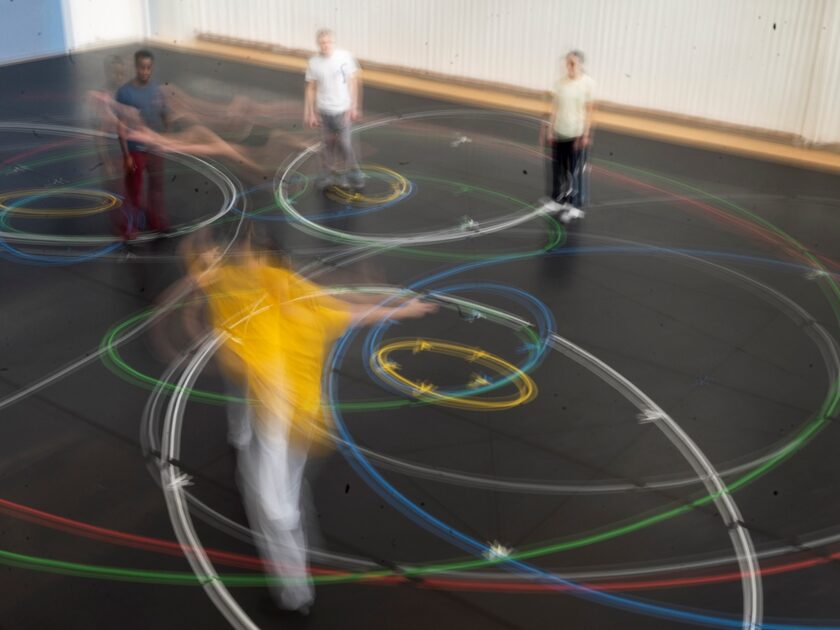
The four pieces De Keersmaeker selects for GLA55 - Music in Contrary Motion, Music in Fifths, Music in Similar Motion, Music with Changing Parts - date from the period 1969-1970. They bear the marks of the encounter with Indian composer and sitar player Ravi Shankar and the austerity of American modern art, by the likes of Sol LeWitt. Anne Teresa De Keersmaeker follows this from a principle that characterises her entire career: minimal abstract material maximised. And she does so in ten movements, in which circles, spirals and ellipses form the main figures. As if in a trance and repetitively obsessive, the dancers spin around their own axis.
An equal vision of Glass' music
In GLA55 , De Keersmaeker brings together the six dancers of Rosas with seven musicians from the Ictus Ensemble (the sixteenth collaboration with De Keersmaeker and for the second time at schrit_tmacher!) and the Bl!ndman Ensemble. Together they will show their like-minded approaches to the music of Philip Glass.
This performance is a co-production with schrit_tmacher NL.

 Dutch premiere